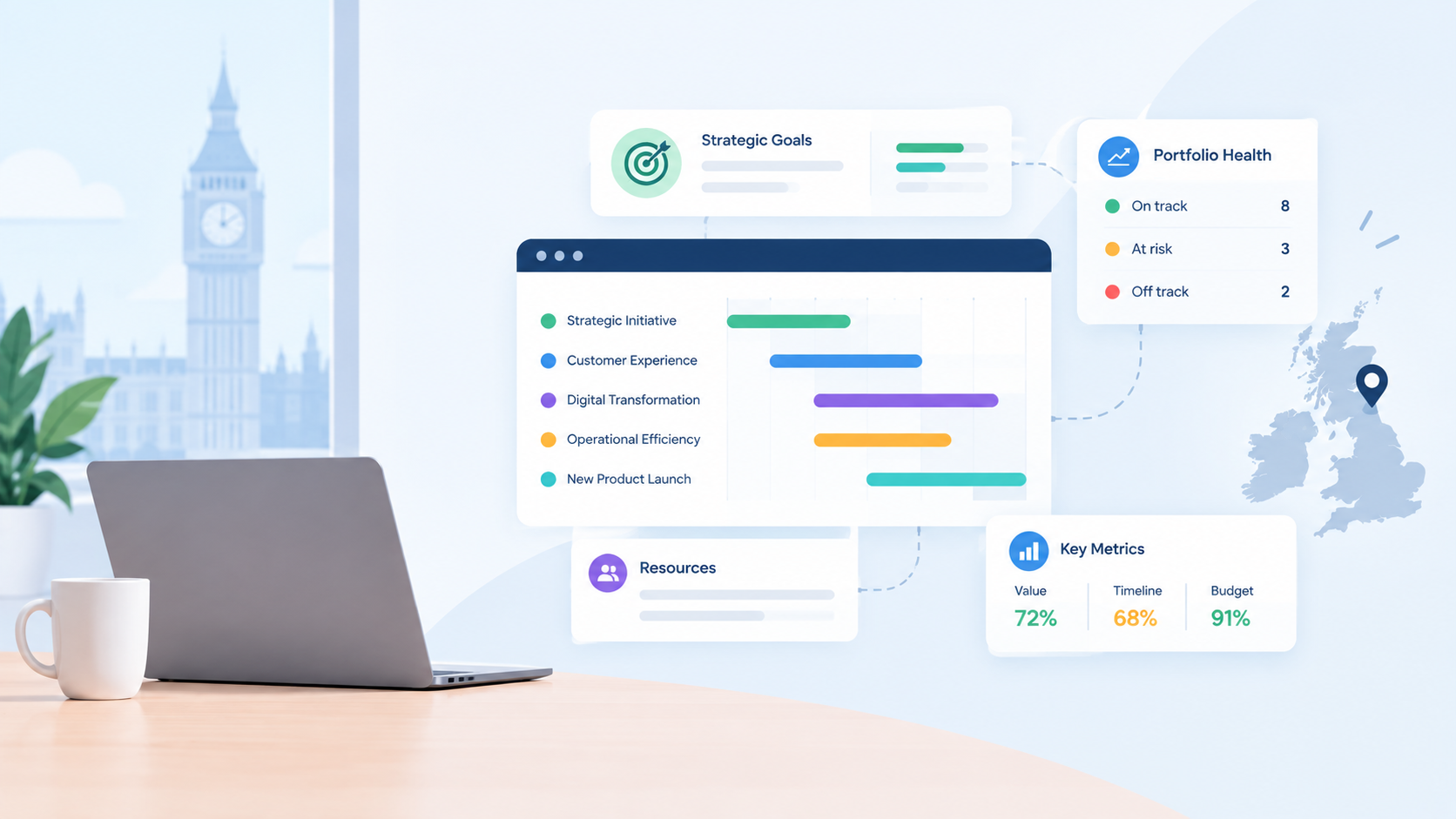

A PMO, or Project Management Office, is the function inside an organisation responsible for setting project management standards, governing the portfolio of projects and programmes, and reporting on whether delivery activity is aligned to strategic objectives.
A PMO is not simply a team that tracks project status. Its real job is to make sure the organisation's work, taken as a whole, is still pointed at the goals leadership agreed to fund. That distinction matters, because it is the one most task management tools were never built to support.
This guide covers what a PMO does day to day, the different types of PMO, common responsibilities by role, and where software fits into the function.
What does a PMO do?
A PMO typically owns four areas of responsibility, though the balance shifts depending on the organisation's maturity and the type of PMO it runs:
- Governance. Setting the standards, templates, and gate process every project follows before it gets funded and while it is delivered.
- Portfolio oversight. Grouping projects and programmes into portfolios aligned to strategic objectives — the discipline covered in full in this project portfolio management guide — and tracking whether that alignment holds over time.
- Reporting. Giving leadership and the board a clear, honest view of status, budget, and strategic health, rather than a collection of individual project updates. See how software turns PMO reporting from a manual, multi-day exercise into something live.
- Resource management. Tracking capacity and allocation across every active project, so over-allocation and burnout risk are visible before they become a crisis.
The common thread across all four is connection. A PMO's value comes from linking individual projects back to the strategy they are meant to serve, not from running any single project better.
The three types of PMO
Not every PMO operates the same way. Most fall into one of three models, distinguished by how much authority the function holds.
| Type | What it does | Level of authority |
|---|---|---|
| Supportive PMO | Provides templates, tools, and best practice on request. Advisory only. | Low |
| Controlling PMO | Requires compliance with defined governance, templates, and reporting standards. | Medium |
| Directive PMO | Directly manages projects and assigns project managers across the organisation. | High |
Many PMOs start supportive and mature into a controlling model as the organisation grows past owner-led decision making into a structured management team, typically once headcount passes 50 or more. Few reach fully directive, and it is rarely necessary outside large, complex portfolios.
PMO roles and responsibilities
PMO Manager. Owns day-to-day portfolio oversight: maintaining the project list, running the governance process, and preparing the strategic view for leadership. Usually the person who can list every active project but is judged on whether they can also show which ones still matter.
Portfolio Manager. Focused specifically on grouping programmes and projects into portfolios aligned to strategic outcomes — see how portfolio, programme, and project roles differ — and tracking budget and progress at that level.
Programme Manager. Manages a set of related projects delivering a shared outcome together, reporting progress up into the portfolio view the PMO maintains.
Project Manager. Delivers an individual project on time, on budget, and on scope, working within the governance standards the PMO has set.
Operational Director or C-suite sponsor. Holds ultimate accountability for whether the portfolio the PMO governs is actually delivering the organisation's strategy, and is usually the audience a PMO's reporting is built for.
Why PMOs struggle to prove their value
A PMO can run flawless governance and still get challenged at board level, because governance alone does not answer the question the board is actually asking: is this portfolio still executing our strategy.
The data suggests this gap is widespread. Only 18% of project professionals show high business acumen, and 70% of large-scale digital transformations fail, typically because the wrong projects were funded rather than because they were poorly managed. A PMO measured purely on delivery metrics such as on-time and on-budget can hit every number and still be unable to answer why the portfolio exists in its current form.
This is the reason PMOs are increasingly expected to report on strategic alignment, not just delivery status. It is also where most PMO tooling falls short, since task and project trackers were built to answer "is it done", not "should it still be on the list."
How software fits into a PMO's role
A PMO's core job, connecting strategy to delivery, is difficult to do manually at any scale beyond a handful of projects. Software matters here in four specific ways:
Objectives and KPIs as structured data. A PMO needs to link a strategic objective to a KPI and see its status update automatically as delivery progresses, rather than rebuilding that link in a spreadsheet before every review.
A governed ideas pipeline. Before a project consumes budget, it should pass through a scored evaluation against strategic fit. Software that supports this stops portfolio bloat at the source.
Portfolio-level resource visibility. A PMO needs to see over-allocation across every project a team member touches, not just within a single project view, to catch burnout risk early.
Executive reporting in one place. RAG status, budget versus actual spend, and objective health should sit in a single dashboard the PMO Manager can pull up in a board meeting, not assemble by hand.
Project Director was built around this structure specifically. Objectives and KPIs sit at the top of the platform, with Business Units, Portfolios, Programmes, and Projects inheriting that strategic context, so a PMO can show the strategy-to-delivery chain without a week of manual reporting.
The practical takeaway
A PMO exists to answer one question a project manager is not positioned to answer alone: is the organisation's work, taken as a whole, still the right work. Governance and reporting support that answer. Software that links strategy to delivery makes it possible to give that answer without a week of manual effort before every board meeting.
Frequently asked questions
What is a PMO in project management?
A PMO (Project Management Office) is the function that sets project management standards, governs the portfolio of projects and programmes, and reports on whether delivery is aligned to strategy.
What does a PMO do day to day?
A PMO handles governance and gate processes, portfolio oversight, reporting to leadership and the board, and resource capacity management across every active project.
What does PMO stand for?
Project Management Office — the function responsible for governance, portfolio oversight, reporting, and resource management across an organisation's projects and programmes.
What's the difference between a supportive, controlling, and directive PMO?
A supportive PMO advises only. A controlling PMO requires compliance with defined governance and reporting standards. A directive PMO directly manages projects and assigns project managers.
Does a small company need a PMO?
Most organisations start without a formal PMO and introduce one as headcount and project volume grow, typically once decision-making moves past a single owner into a structured management team.
What's the difference between a PMO Manager and a Portfolio Manager?
A PMO Manager owns day-to-day governance and the strategic view for leadership. A Portfolio Manager is focused specifically on grouping programmes and projects into portfolios aligned to strategic outcomes.
See whether your portfolio still matches your strategy. Get 14 days free, no credit card required.