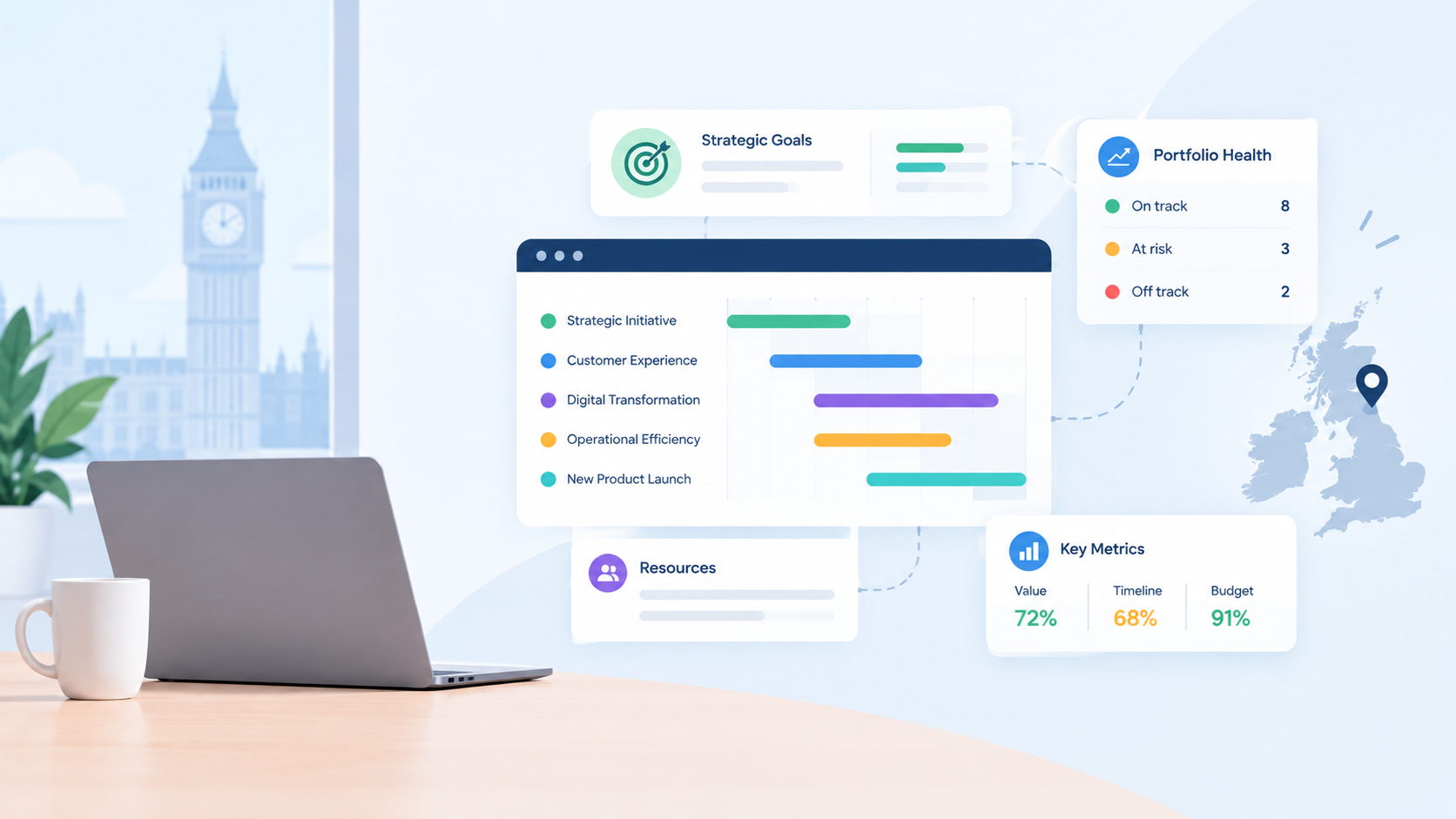

Most PPM software evaluation criteria, strategic alignment, KPI tracking, resource capacity, apply regardless of geography. A UK-based organisation has a shorter list of additional questions layered on top: where is data actually hosted, does the vendor meet UK data protection requirements, is the platform priced and supported in a way that matches how a UK mid-market organisation actually buys and runs software. This guide covers that shorter, UK-specific list.
If you haven't already, our PPM software buyer's guide covers the full evaluation criteria: strategy-to-delivery linkage, KPI tracking, resource capacity, and the questions to ask any vendor regardless of where they're based. This guide picks up where that one leaves off, on the specific checks a UK PMO should run before signing.
Data residency and GDPR
Where is the data actually hosted. Many PPM vendors, particularly larger US-headquartered platforms, host data in US or mixed-region data centres by default, with UK or EU hosting available only on enterprise tiers, if at all. Ask this directly rather than assuming a vendor with a UK sales presence hosts data in the UK.
GDPR compliance, not just a mention of it. Every vendor selling into the UK will reference GDPR somewhere on their site. The more useful question is whether they can name their lawful basis for processing, their data processing agreement terms, and what happens to your data on contract termination, specifically whether it is deleted, exported, or retained, and for how long.
Sub-processor transparency. If the vendor uses third-party infrastructure providers, ask for a list of sub-processors and where each one is based. A UK-hosted primary platform that relies on a US-based analytics or support sub-processor may still create data transfer questions worth understanding before you commit.
Sector-specific regulatory considerations
Finance and Insurance. Organisations regulated by the FCA or PRA should check whether the vendor has experience with financial services clients specifically, since operational resilience and third-party risk management expectations under UK financial regulation extend to the software vendors a regulated firm relies on for portfolio and project oversight.
IT and SaaS. Less direct regulatory burden than financial services, but if your own organisation holds client data through the projects you deliver, check that the PPM platform's own security posture, Cyber Essentials certification, ISO 27001, or equivalent, would satisfy a client audit of your supply chain.
Retail. If any tracked projects touch payment systems or customer data platforms, the same due diligence that applies to your own PCI DSS or data protection obligations should extend to any tool holding project detail about those systems, even if the PPM tool itself never touches live customer data.
UK-based vendors versus international platforms
The PPM and adjacent PM market includes a mix of UK-headquartered vendors and larger international platforms with a UK presence. Each brings different trade-offs.
UK-based or UK-focused vendors tend to have a clearer answer on data residency by default, often host in UK or EU data centres as standard rather than an add-on, and may have deeper familiarity with UK-specific buying patterns, such as the 4 to 6 week evaluation-to-proposal cycle common in UK mid-market procurement.
Larger international platforms, including task management tools like Asana and Monday.com, and strategy-focused tools like i-Nexus, typically offer more mature integration ecosystems and larger support organisations, but UK data residency and support hours may require a specific enterprise tier or an explicit request rather than being the default.
Neither category is automatically the right choice. The point is to ask the UK-specific questions directly of any vendor, rather than assuming a UK office address answers them.
Currency, contracts, and procurement
Pricing in GBP, not converted USD. Check whether pricing is quoted natively in GBP or converted from a US dollar list price at the point of invoicing, since the latter exposes your budget to exchange rate movement over a multi-year contract.
VAT treatment. Confirm whether quoted pricing is VAT inclusive or exclusive, and how VAT is handled if your organisation has any cross-border entities.
Contract length and minimum commitment. UK mid-market buying cycles often run 4 to 6 weeks from enquiry to proposal, frequently including a short evaluation period before commercial terms are agreed. Check whether the vendor's standard contract length and minimum seat commitment, some tools set a minimum adoption threshold such as 20 users, matches your actual buying group size before assuming the advertised per-seat price is your real cost.
Support and timezone
Support hours aligned to UK working hours. A vendor based in the US Pacific time zone may offer support hours that only partially overlap with a UK working day, which matters more during initial implementation and onboarding than it does once the platform is embedded.
Onboarding delivered by someone who understands UK PMO structures. UK organisations, particularly mid-market ones moving from owner-led structures into a formal PMO function, often have specific questions about how to structure Business Units, Portfolios, and Programmes that reflect a UK management hierarchy. A vendor whose onboarding team has worked with similar UK organisations before will generally answer these faster than one translating a generic global playbook.
How Project Director addresses UK-specific requirements
Project Director was built for the UK market specifically, not adapted from a US-first product afterward. A few implications of that follow directly from the questions above.
Geography. The platform targets UK organisations exclusively at this stage, with UK-based hosting rather than data residency treated as an enterprise add-on.
Pricing. £15 per seat, per month, quoted in GBP, with a minimum adoption of 20 users, so currency exposure and minimum commitment are both known upfront rather than negotiated case by case.
Buying process. The enquiry to evaluation to proposal cycle runs 4 to 6 weeks, including a 14-day free trial, matching the buying cadence UK mid-market organisations already run internally rather than requiring you to adapt to an unfamiliar sales process.
Sector fit. The platform's priority verticals, IT and SaaS, Finance and Insurance, and Retail, are the same sectors this guide addresses directly, so onboarding and implementation guidance is built around scenarios UK PMOs in those sectors actually encounter.
Frequently asked questions
Does GDPR compliance depend on where a PPM vendor is headquartered? Not entirely. A vendor headquartered outside the UK or EU can still be GDPR compliant for UK customers, provided appropriate safeguards, such as adequacy decisions or standard contractual clauses, are in place for any data transfer. What matters more in practice is where the data is actually hosted and processed, which is worth confirming directly rather than inferring from the vendor's registered address.
Is UK data hosting a legal requirement for PPM software? Generally no, unless your organisation operates under specific regulatory requirements, such as certain financial services rules, that mandate UK or EU data residency. Many organisations choose UK hosting as a preference for simpler compliance and clearer accountability, rather than because it is strictly mandated.
Should a UK organisation prefer a UK-based PPM vendor over an international one? Not automatically. The right choice depends on which vendor actually meets your specific requirements on data residency, sector experience, and support, rather than vendor location alone. A UK-based vendor is more likely to meet UK-specific expectations by default, but international vendors can meet them too, provided you confirm it directly.
What UK-specific certification should a PPM vendor be able to show? Cyber Essentials or Cyber Essentials Plus is a reasonable baseline expectation for a UK-focused software vendor. ISO 27001 is a stronger indicator for organisations with more demanding security requirements, particularly in regulated sectors like Finance and Insurance.
The practical takeaway
The core evaluation criteria for PPM software, covered in full in our buyer's guide, apply everywhere. What changes for a UK buyer is a short, specific checklist layered on top: where data is hosted, whether GDPR and sector regulation are genuinely satisfied rather than referenced in passing, whether pricing and contracts are structured in GBP with UK buying cycles in mind, and whether support hours actually overlap with a UK working day. Run both lists, and the evaluation covers what actually matters for where your organisation operates.
See whether your portfolio still matches your strategy. Start your 14-day free trial, no credit card required.