
Project Director is the strategic project & portfolio management platform. It gives your PMO live portfolio and programme visibility, a scored gate on new ideas, and resource and risk oversight in one place — so governance becomes a strategic function rather than a reporting one.
Start your free 14-day trial →What PMO reporting looks like every single week
“Can you send me the latest portfolio summary?”
You spend two days consolidating spreadsheets to answer a question the system should answer instantly.
“Is this project still aligned to our strategy?”
You can see what’s running. You can’t prove whether it should be. That gap is where credibility gets lost.
“Why did we miss that risk?”
Because the tools you have track tasks. None of them surface risk across a portfolio before it becomes a crisis.
What you get
Every portfolio, programme and project is linked to the strategic objective it’s meant to deliver. You see the full picture instantly. No more chasing updates, no more manual rollups. Governance is built in, not bolted on.
Score every idea against strategic fit before it gets funded. Only work that earns its place gets through. You stop portfolio bloat before it starts and you can defend every approved project to the board.
Projects at risk are flagged the day they appear. Resource over-allocation is visible 12 months ahead. RAG status is live, timestamped, and auditable. You stop reacting and start managing.
Portfolio view
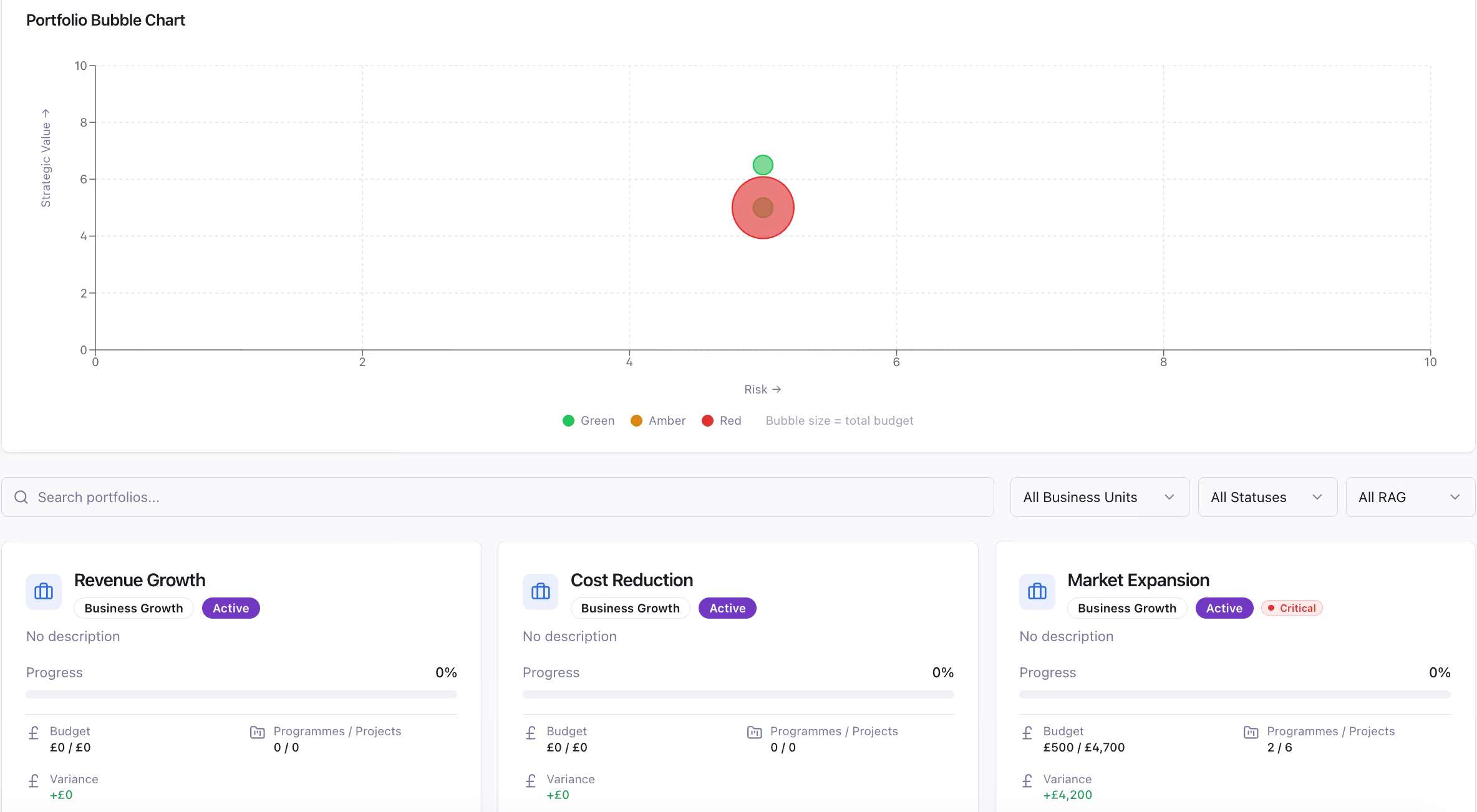
The manual status-report cycle: pulling updates from each project, consolidating them into a deck, and repeating it every reporting period. Project Director keeps portfolio, programme, and risk status live instead.
Most PMOs spend around two days per cycle consolidating spreadsheets and project updates into a single portfolio summary. A live dashboard removes that assembly step entirely.
No. Task management tools track day-to-day work within a project. Project Director sits above that layer, connecting objectives, KPIs, portfolios, and programmes so the PMO can report on strategic alignment, not just task completion.
What does Project Director do that our project management tool doesn't?
Your project tool tracks the work. Project Director tells you whether the work should be on the list. It connects strategic objectives and KPIs to the portfolios, programmes and projects delivering them, so the PMO can answer questions about strategic contribution, not just status.
How long does it take to get our portfolio into Project Director?
Most PMOs are set up inside the 14-day trial. You define your business units, add objectives and the KPIs that measure them, then group existing projects into portfolios and programmes. No integration work is required because everything lives in one platform.
Can we structure portfolios and programmes the way we actually work?
Yes. Group work by strategic outcome, by business unit, or however your organisation is structured. Each business unit carries its own objectives, KPIs and reporting currency, so the hierarchy bends to fit you.
How does the ideas gate stop the portfolio filling up?
Ideas are captured with a type and description, scored for alignment against portfolio objectives, then set to Draft, Under Review, Approved or Rejected. Nothing consumes budget or headcount until it clears the gate, so the PMO decides what enters the portfolio rather than discovering it later.
Can we connect the tools our delivery teams already use?
Resource Capacity gives a rolling 12-month view of who is allocated where across every active project, with counts for fully utilised and over-allocated people. You see the constraint forming months ahead rather than when someone resigns.
How much does it cost for a PMO team?
£15 per seat, per month, with a minimum of 10 seats, so £150 per month as a floor. Every feature is included at that price, and stakeholders invited as read-only viewers through a shared link do not count as seats.
One portfolio. See what it feels like to have the whole picture in one place.
