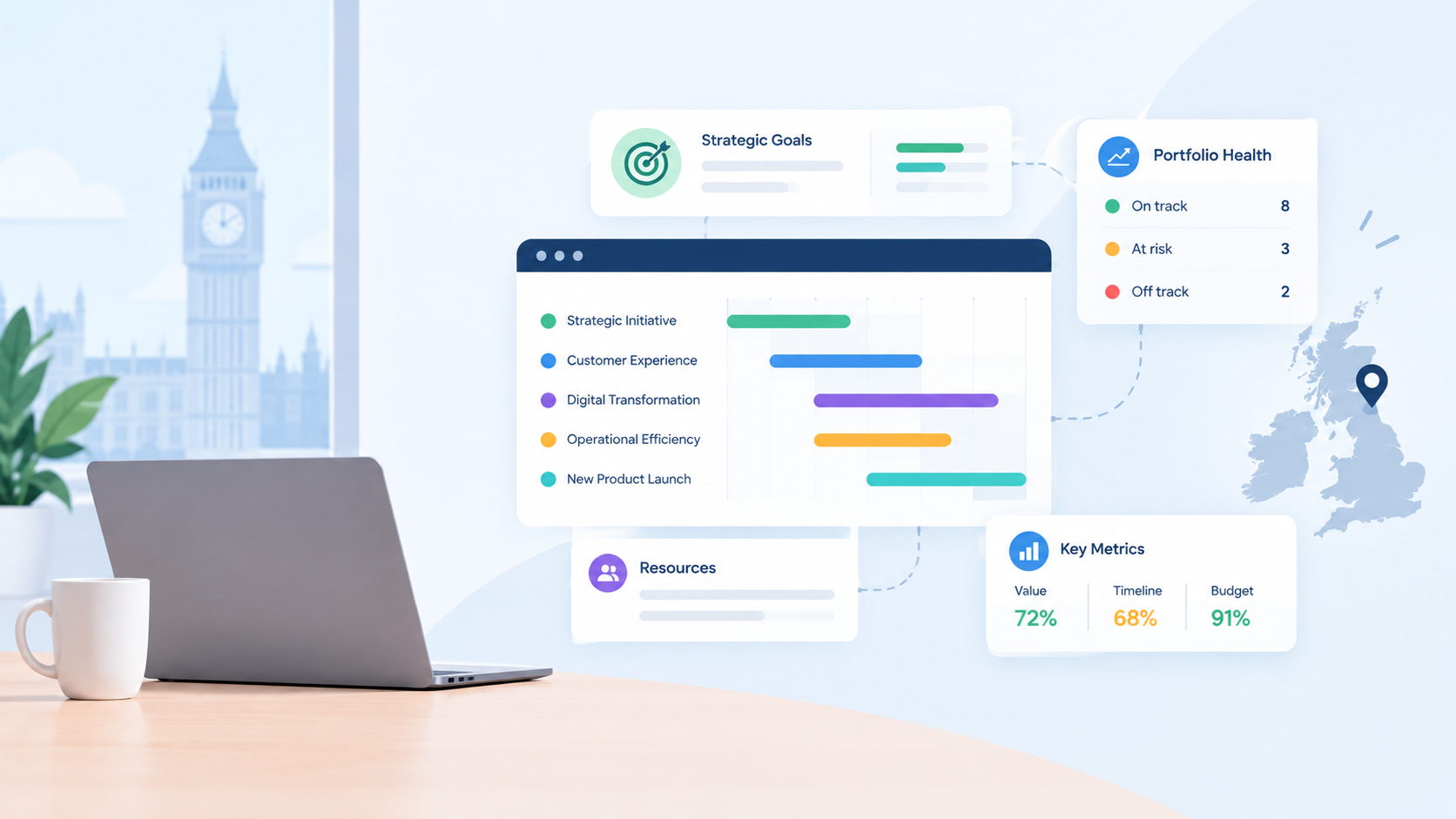
Project Director is a project portfolio management platform built for UK organisations. It links an organisation's strategic goals, objectives, and KPIs directly to the portfolios, programmes, and projects delivering against them, giving PMOs a single, live view of whether the work being funded is still the work the strategy needs.
Most project tools answer whether tasks are getting done. Project Director was built to answer the question sitting one level above that: is the work being done still the right work. This overview covers what the platform includes, who it's built for, what it costs, and how it differs from the tools most PMOs are already using.
What Project Director does
Project Director organises everything around a single structure: a Business Unit sits at the top of an organisation, with Objectives and KPIs defined against it, and Portfolios, Programmes, and Projects nested beneath, each inheriting the strategic context of the level above. A project created inside a programme automatically carries that programme's portfolio linkage, so the connection from strategy to delivery holds without anyone maintaining it by hand.
This structure is what separates Project Director from task management tools like Asana or Monday.com, which track individual work well but were never built to hold a strategic objective as a linked, structured object. It is also what separates it from pure strategy tools like i-Nexus, which articulate strategy at board level but disconnect from day-to-day delivery. Project Director sits deliberately between the two.
Core features
Home dashboard. A live executive view showing Objectives Health, KPI Health, Portfolio Financial Health, and Project RAG status in one place, alongside licence usage, projects at risk, and upcoming milestones across the organisation.
Business Units. The organisational anchor point, with five tabbed views (Objectives, KPIs, Portfolios, Programmes, Projects) showing everything beneath it in one place. See our guide on what a PMO actually does for how this maps to PMO responsibilities.
Objectives and KPIs. Strategic objectives with a status, progress percentage, and target date, each linked to one or more KPIs carrying a category, owner, measurement frequency, and status. For a deeper look at how to structure these, see our guide to PMO KPI dashboards.
Portfolios and Programmes. Portfolios group programmes and projects around a shared strategic outcome; programmes group related projects delivering that outcome together. Our guide on portfolio vs programme vs project covers this distinction in full.
Projects. Individual execution units that inherit the strategic context of their parent programme and portfolio automatically.
Ideas and Opportunities. A structured pipeline for capturing, scoring, and gating candidate work before it consumes budget, moving through Draft, Under Review, Approved, and Rejected status. See our full breakdown of the project portfolio management process for how this fits the wider PPM cycle.
Resource Capacity. A live view of team member utilisation and allocation across every active project, flagging over-allocation before it becomes a missed deadline, with a rolling 12-month capacity timeline.
RAG status. Red, Amber, Green execution status at project and portfolio level. Our guide to RAG status reporting covers how to set thresholds and read status as a trend rather than a snapshot.
User Management. Invite, manage, and configure team members, with licence usage and renewal dates visible at all times.
Who Project Director is for
Company profile. UK organisations with 50 to 500 employees, past owner-led decision making and into a structured management team, in IT and SaaS, Finance and Insurance, or Retail.
PMO Manager. Owns day-to-day portfolio oversight and governance, and is usually the person judged on whether they can connect the project list to the strategy deck without a week of manual work. See our guide on PMO roles for how this fits alongside other roles in the function.
Portfolio Manager. Focused on one or more portfolios, tracking whether the programmes and projects inside them are collectively delivering the strategic outcome they were grouped to achieve.
Operational Director. The typical economic buyer, has bought project tools before and is looking for one that finally answers the questions the CEO actually asks.
C-Suite Sponsor. Cares less about which tool the team uses day to day and more about whether the board's question, are we executing our strategy, gets a clean, current answer. Our piece on what executives actually need from portfolio reporting covers this directly.
Pricing
| Detail | Value |
|---|---|
| Price | £15 per seat, per month |
| Minimum adoption | 20 users |
| Trial | 14-day free trial, no credit card required |
| Sales cycle | 4 to 6 weeks total |
| Buying process | Enquiry, evaluation, proposal |
Pricing is quoted in GBP, with no minimum enterprise tier required to access core reporting features. For a full breakdown of how to evaluate this against other platforms, see our PPM software buyer's guide and our guide specifically for UK-based buyers.
How Project Director differs from other tools
How Project Director differs from other tools
| Capability | Asana / Monday.com | Project Director |
|---|---|---|
| Strategy-to-delivery linkage | No | Yes |
| Objectives management | No | Yes |
| KPI tracking linked to portfolios | No | Yes |
| Portfolio management | Limited | Yes |
| Programme management | No | Yes |
| Ideas pipeline with strategic scoring | No | Yes |
| Cross-portfolio resource capacity | Limited | Yes |
| Executive RAG status across all projects | No | Yes |
| Budget vs. actual tracking | No | Yes |
For a full comparison of the underlying category difference, see PPM software vs task management software.
Frequently asked questions
What kind of company is Project Director built for? UK mid-market organisations, typically 50 to 500 employees, in IT and SaaS, Finance and Insurance, or Retail, that have moved past owner-led decision making into a structured management team and need to show a board that their project portfolio is still aligned to strategy.
How much does Project Director cost? £15 per seat, per month, with a minimum adoption of 20 users. A 14-day free trial is available with no credit card required.
Is Project Director a replacement for Asana or Monday.com? Not necessarily. Project Director operates at the portfolio and strategy layer, while task management tools operate at the individual work layer. Some organisations run both during a transition, using Project Director for portfolio-level reporting and their existing tool for day-to-day task tracking.
How long does it take to get started with Project Director? The buying process typically runs 4 to 6 weeks from enquiry to proposal, including a 14-day evaluation period where most PMO teams see their first alignment gaps surface using their own project data.
The practical takeaway
Project Director exists because most project tools answer whether work is getting done, and almost none answer whether it should be on the list at all. It connects objectives and KPIs directly to portfolios, programmes, and projects, gives PMOs a live view of execution and strategic alignment together, and is priced and built specifically for UK mid-market organisations trying to prove their portfolio still matches their strategy.
See whether your portfolio still matches your strategy. Start your 14-day free trial, no credit card required.