
A project is a single piece of work with a defined scope, timeline, and deliverable. A programme is a group of related projects delivering a shared outcome together. A portfolio is a collection of programmes and projects, often unrelated to each other in scope, unified by a common strategic objective. The three sit at different levels of the same structure, and each answers a different question.
Get the three confused, and reporting confuses with them. A project status update, a programme progress report, and a portfolio strategic review are not the same document answering the same question at different levels of detail. They are three different questions entirely, and treating them as interchangeable is one of the most common ways PMO reporting quietly breaks down.
This guide defines each term clearly, walks through real examples, and explains why the distinction matters more than it looks.
What is a project?
A project is a temporary piece of work with a defined start, end, scope, and deliverable. It is owned by a Project Manager, whose job is to deliver it on time, on budget, and within the agreed scope.
A project answers one question: is this specific piece of work being delivered as planned.
Example. A mobile app redesign, a payroll system migration, or a new customer onboarding flow are each individual projects. Each has its own timeline, budget, and deliverable, distinct from any other work happening around it.
What is a programme?
A programme is a group of related projects, managed together because they contribute to a shared outcome that none of them could deliver alone. A programme is owned by a Programme Manager, who tracks progress, budget, and dependencies across every project inside it.
A programme answers a broader question: are these related pieces of work, taken together, delivering the outcome we grouped them to achieve.
Example. A Digital Channels Programme might contain a mobile app modernisation project, a customer data platform project, and a new self-service portal project. None of those three projects alone delivers "improved digital customer experience." Together, tracked as a programme, they do.
What is a portfolio?
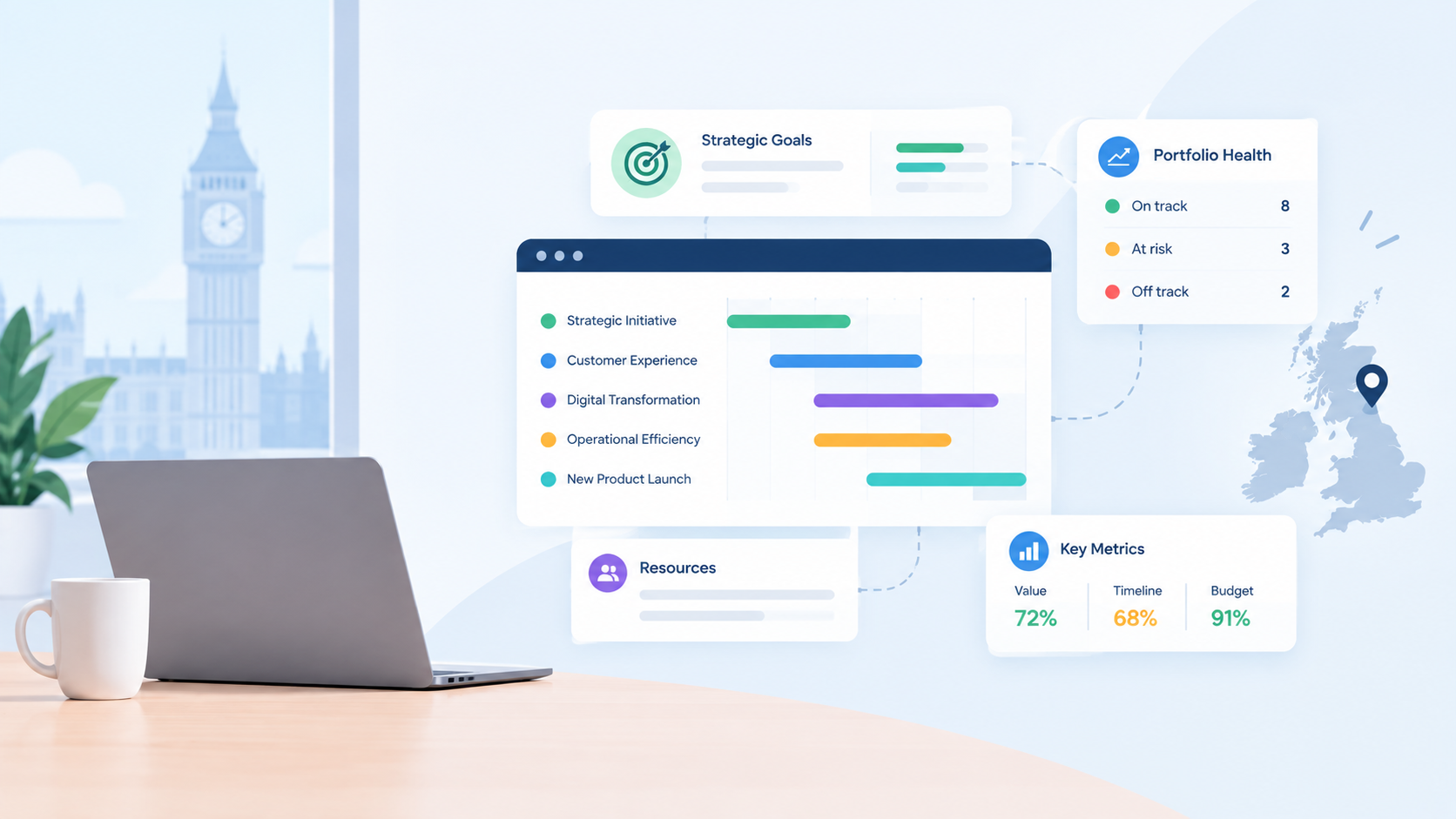
A portfolio is a collection of programmes and projects, often spanning different teams and disciplines, unified not by working together operationally but by a shared strategic objective. A portfolio is typically owned at PMO or Portfolio Manager level, reporting into an Operational Director or C-suite sponsor.
The ongoing discipline of deciding what belongs in that portfolio, and keeping the whole set of funded work aligned to strategy over time, is project portfolio management.
A portfolio answers the question a board actually cares about: is this entire set of funded work, taken together, still pointed at the strategic goal it was approved to support.
Example. A Customer Digital portfolio might contain the Digital Channels Programme described above, alongside a standalone customer service automation project that has no operational dependency on the programme but shares the same strategic aim: improving the customer digital experience.
Portfolio vs programme vs project, side by side
| Level | Question it answers | Scope | Typical owner | Reporting horizon |
|---|---|---|---|---|
| Project | Is this piece of work on time, on budget, on scope? | A single, defined deliverable | Project Manager | Weeks to months |
| Programme | Are these related projects delivering a shared outcome together? | Multiple interdependent projects | Programme Manager | Months to a year |
| Portfolio | Is this entire body of work still aligned to strategy? | Programmes and projects, often unrelated operationally | PMO or Portfolio Manager | Ongoing, reviewed quarterly or annually |
A useful way to hold the distinction: projects are about delivery, programmes are about coordination, and portfolios are about direction.
Why mixing up the three breaks PMO reporting
Confusing these levels is not just a terminology problem. It has three concrete consequences.
Board reporting gets the wrong altitude. A board does not need a project-level update on every workstream. It needs a portfolio-level answer to whether strategic objectives are on track. A PMO that reports at project level to a board audience buries the one answer the room actually wants under detail nobody asked for.
Resource conflicts go undetected. A team member can appear fully allocated within a single project and still be over-committed once every project they touch, across multiple programmes and portfolios, is counted together. Tracking allocation only at project level hides this until it becomes a missed deadline.
Strategic drift becomes invisible. A project can be delivered flawlessly and still contribute nothing to the strategic objective its portfolio was funded to support. That gap is only visible if the portfolio level is tracked separately from project-level RAG status, not treated as a simple roll-up of it.
Common mistakes in how organisations structure this
Treating a portfolio as just a bigger programme. A programme groups projects that depend on each other operationally. A portfolio groups work by shared strategic intent, and the projects inside it may have no operational relationship at all. Structuring a portfolio as though every project inside it must be interdependent misses the point of having one.
Skipping the programme level entirely. Some organisations run projects directly under a portfolio with no programme layer in between. This works at small scale, but as the number of related projects grows, losing the programme layer means losing the view of how those specific projects are coordinating with each other.
Letting reporting formats blur the levels. If a project status report, a programme progress report, and a portfolio strategic review all look identical, the underlying confusion about what each level is for usually runs deeper than the template.
How software should structure this hierarchy
A platform built to support this structure properly should let each level inherit context from the one above it, rather than treating portfolios, programmes, and projects as flat, disconnected lists.
Objectives sit above portfolios. Every portfolio should trace back to a named strategic objective, not exist as a container with no stated purpose.
Programmes belong to a portfolio, and projects belong to a programme. When a project is created, it should automatically inherit the strategic context of the programme and portfolio above it, rather than requiring someone to manually tag the relationship.
Each level has its own reporting view. A Business Unit should offer separate tabs for Objectives, KPIs, Portfolios, Programmes, and Projects, so a PMO Manager can move between altitudes without switching tools.
Project Director is structured exactly this way. A Business Unit sits above everything, with Portfolios, Programmes, and Projects nested beneath it, each inheriting the strategic context of the level above. A project created inside a programme automatically carries that programme's portfolio linkage, so the chain from strategy to delivery stays intact without manual tagging.
The practical takeaway
Project, programme, and portfolio are not three sizes of the same thing. They are three different questions: is this piece of work on track, are these related pieces of work delivering together, and is this entire body of funded work still aligned to strategy. Getting the distinction right in how you structure and report on your work is what makes it possible to answer all three honestly, at the same time, without one drowning out the others.
See how Project Director keeps portfolios, programmes, and projects connected end to end, with each level inheriting context from the one above it. Start the 14-day evaluation.