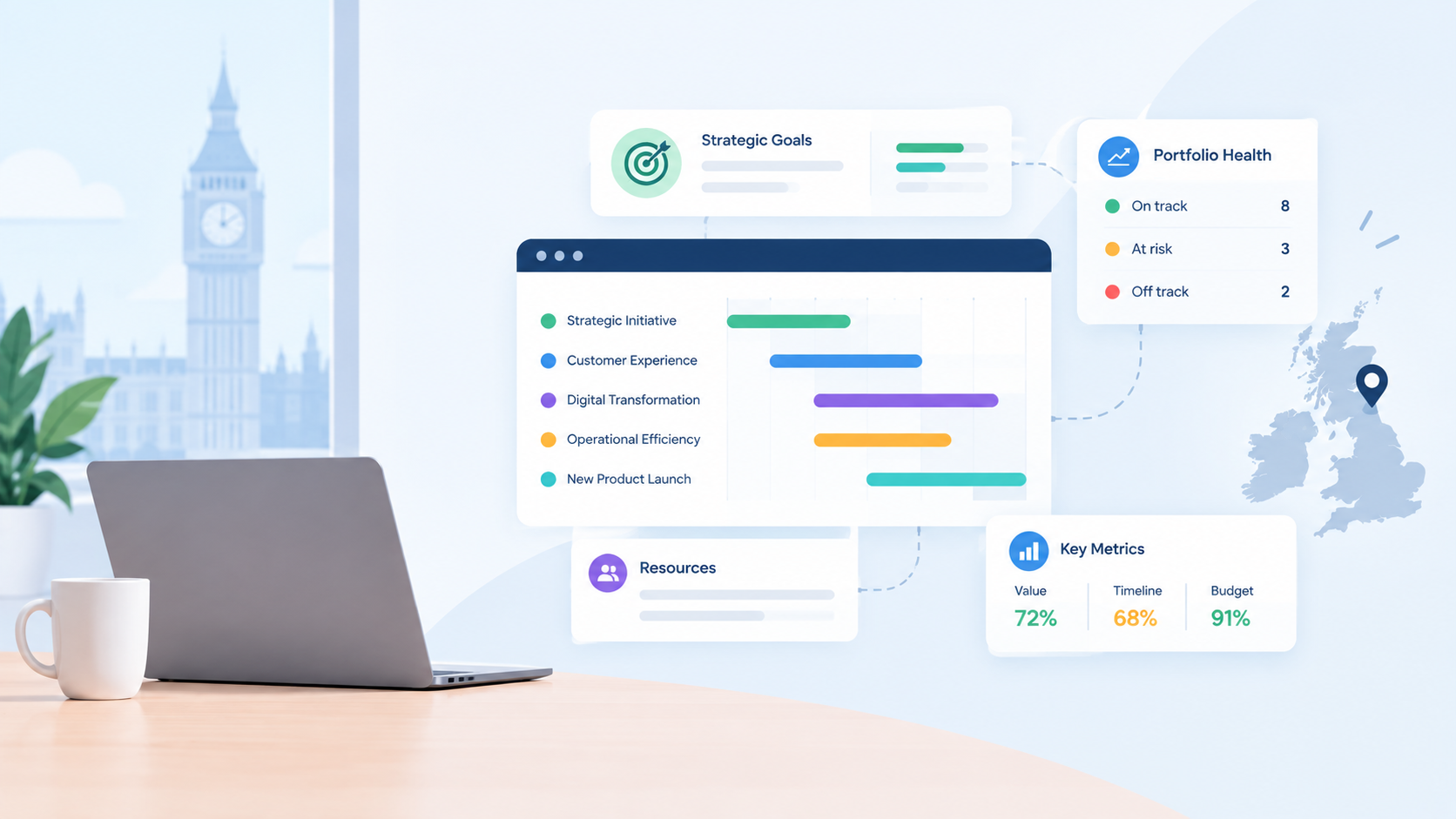

Project portfolio management (PPM) is the practice of prioritising, grouping, governing, and overseeing an organisation's projects and programmes as a single portfolio, so delivery stays connected to strategy instead of running as a list of disconnected initiatives.
Where project management asks "is this project on track", portfolio management asks "should this project be in the portfolio at all, and is the portfolio as a whole still pointed at the right goals." For a PMO, that second question is usually the harder one to answer, and the one the board actually cares about.
This guide covers what PPM involves, how it differs from project and programme management, the process most PMOs follow, and what to look for in PPM software.
What does project portfolio management actually involve?
PPM sits above individual projects and covers four connected activities:
- Prioritisation. Deciding which projects and initiatives get funded, based on strategic fit, not just resource availability.
- Grouping. Organising related programmes and projects into portfolios aligned to a specific strategic outcome, such as customer digital transformation or financial restructuring.
- Governance. Setting the gate process new ideas go through before they consume budget and headcount.
- Oversight. Tracking status, budget, and resource allocation across the whole portfolio, not just project by project.
Done well, PPM gives a PMO Manager one answer to the question a board will always ask eventually: are we funding the right work.
Project management vs programme management vs portfolio management
These three terms get used interchangeably, which causes most of the confusion around PPM. In short: project management asks whether a single piece of work is on track, programme management asks whether related projects are delivering a shared outcome together, and portfolio management asks whether the whole funded body of work is still pointed at the right strategic goals.
For the full breakdown of scope, ownership, and reporting cadence at each level, see portfolio, programme, or project: what's the difference.
A project can be perfectly delivered and still be the wrong project. Portfolio management is the layer that catches that, because it is the only layer built to ask the question in the first place.
Why does project portfolio management matter for a PMO?
Without portfolio-level oversight, a PMO ends up with a list of projects and no reliable way to say which ones matter most. That has a real cost. Only 18% of project professionals show high business acumen, and 70% of large-scale digital transformations fail, not because the projects were badly run, but because the wrong projects were funded in the first place.
Portfolio management gives a PMO three things a project-by-project view cannot:
A prioritisation mechanism. When budget or resource is tight, PPM gives you a structured way to decide what gets funded, accelerated, or stopped, instead of defaulting to whichever project shouts loudest.
Visibility for the board. A portfolio view lets a PMO Manager show, in one place, how delivery activity maps back to the strategic objectives the board signed off.
Early warning on resource strain. Portfolio-level resource tracking surfaces over-allocation across every active project before it turns into burnout or missed deadlines, something a single project dashboard cannot show.
The project portfolio management process, step by step
Most mature PMOs run some version of this cycle:
- Capture. New ideas and opportunities enter a structured pipeline, tagged by type and scored for strategic fit, before they become funded projects.
- Evaluate. Ideas are assessed against portfolio objectives. Not everything that is a good idea is a good fit for this year's strategy.
- Approve or reject. Ideas move through a gate: draft, under review, approved, or rejected. This is what stops portfolio bloat.
- Group. Approved projects are assigned to a programme and a portfolio aligned to a specific strategic outcome.
- Track. Budget, RAG status, KPI progress, and resource allocation are monitored at the portfolio level, not just within each project.
- Review and rebalance. Portfolios are periodically reviewed against strategy, and projects that have drifted from the objective they were funded to support get flagged, defunded, or stopped.
The step most PMOs skip is the last one. It is also the one that prevents a portfolio from quietly drifting away from strategy over a year without anyone noticing.
What to look for in project portfolio management software
Not all PPM tools do the same job. Many task management platforms describe themselves as portfolio tools while only offering a way to group projects visually, with no real link back to strategy. When evaluating PPM software, check for four capabilities specifically:
Objectives and KPIs as first-class data, not a text field bolted onto a project. You should be able to link a KPI to a portfolio and see its status update as delivery progresses.
A structured ideas pipeline with scoring against strategic fit, so prioritisation happens before a project consumes budget, not after.
Cross-portfolio resource capacity, showing over-allocation across every active project a team member touches, not just within one project view.
Executive-level reporting, including RAG status, budget versus actual spend, and objective health, in a single dashboard rather than a manually assembled deck before every board meeting.
Project Director was built around exactly this structure: Objectives and KPIs sit at the top of the platform, with Portfolios, Programmes, and Projects inheriting that strategic context automatically, so the alignment is visible without a week of manual reporting.
The practical takeaway
Project portfolio management is not an extra layer of process on top of project management. It is the layer that answers the question project management was never built to answer: is this the right work?
For a PMO Manager, getting that layer right is the difference between reporting on projects and being able to defend a portfolio in front of a board. Project Director links objectives, KPIs, portfolios, programmes, and projects in one system, so that answer is always visible.
Frequently asked questions
What's the difference between project management and project portfolio management?
Project management delivers a single piece of work on time and on budget. Project portfolio management decides which projects deserve funding in the first place, and tracks whether the whole set is still aligned to strategy.
Who owns project portfolio management in an organisation?
Typically a PMO Manager or Portfolio Manager, reporting into an Operational Director or C-suite sponsor who holds ultimate accountability for the portfolio.
What software features matter most for PPM?
Objectives and KPIs as structured data, a governed ideas pipeline, cross-portfolio resource capacity, and executive-level reporting that doesn't require manual assembly.
How often should a portfolio be reviewed?
Most mature PMOs review and rebalance portfolios quarterly, catching projects that have drifted from the strategic objective they were originally funded to support.
See whether your portfolio still matches your strategy. Take the FREE 14-day evaluation.