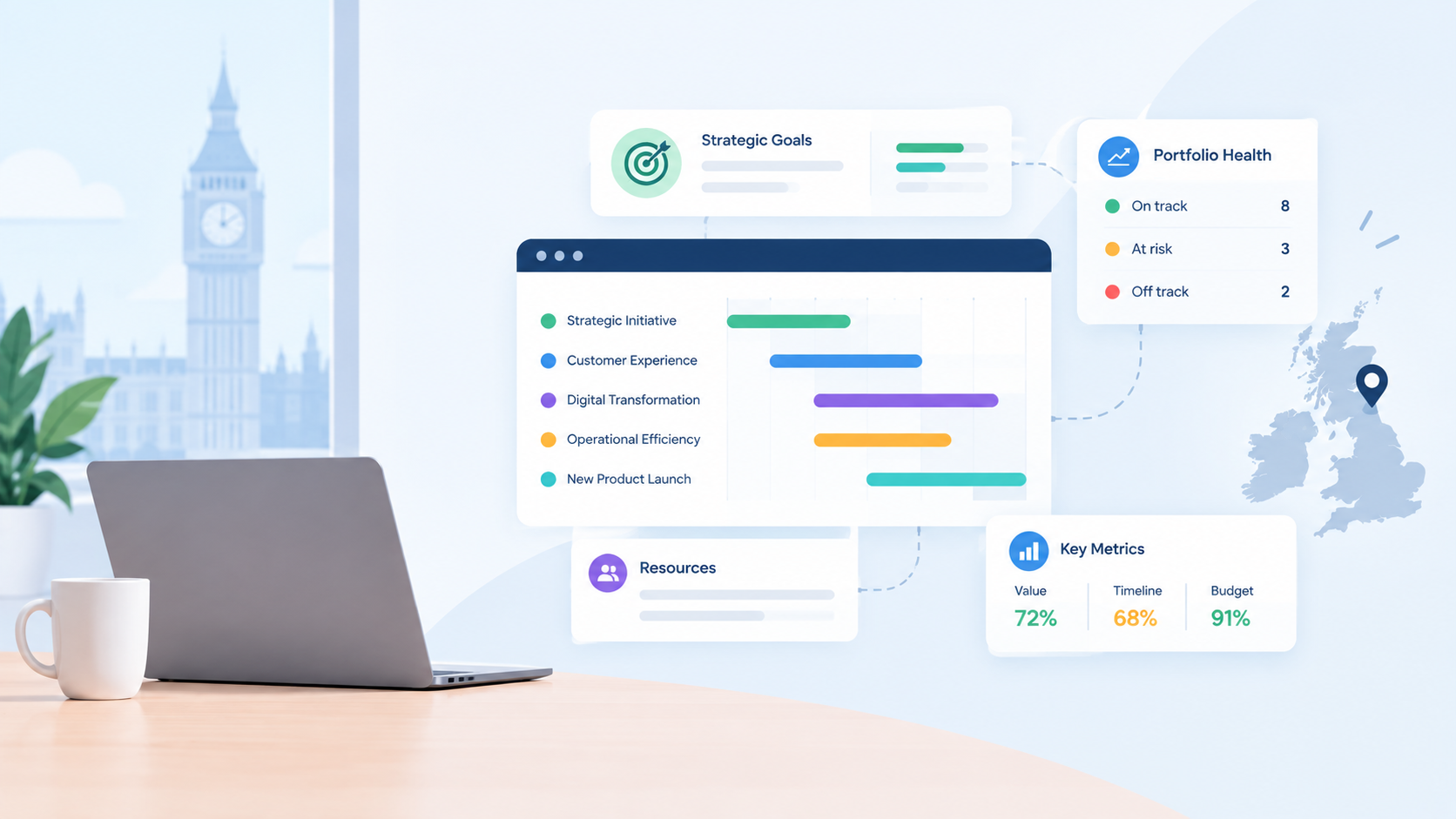

Most organisations frame the case for a new platform around features: better dashboards, cleaner reporting, reports, easier updates. Leadership buys outcomes. That outcome, in most organisations, is better project portfolio management — not a longer feature list.
If the business case for your new tool does not answer the question the board actually asks — are we executing our strategy? — it will be approved politely and deprioritised quietly.
Why Feature-Led Business Cases Get Politely Declined
Showing leadership a better Gantt chart does not move them forward. Showing them that the current tools cannot tell them whether the portfolio still matches the strategy, and that this gap contributed to three failed initiatives last year does.
The feature-led business case frames the tool as a solution to the organisation's problem: we need better reporting, better visibility, better dashboards. Leadership sees this as an internal systems request, they will not see it as a step-change and politely move on.
The outcome-led business case frames the tool as a solution to the organisation's problem: the board cannot answer the strategy execution question cleanly, the portfolio is not defensible, and the cost of that gap, in failed projects and wasted resources. Leadership will engage with it differently. The potential outcomes have been framed.
The Questions Leadership Will Ask and How to Answer Them
Before any platform decision is made, leadership will have concerns. Anticipate them.
"Is it secure?" Project Director is built to enterprise-grade security standards.
"Is it overkill, too much for what we need?" 10 seats, £15 per seat per month, a free 14-day evaluation before any proposal. The entry point is designed to be low-risk and there is no large upfront commitment.
"Will the team actually use it?" Project Director serves every role, not just the team. Project Director is built for the Executive, the PMO Team, Portfolio Managers, Programme Managers and the project manager — each with their own needs.
"What is the ROI?" Connect it to the cost of the last portfolio misalignment, the latest failed project. Each has a cost, which is insignificant in relation to the cost to an organisation of not being able to deliver projects effectively.
How to Frame the Right Problem
"Right now, if the board asked which of our 14 active projects are still aligned to this year's three strategic objectives — how long would it take us to answer that?"
If the honest answer is "several days and a lot of spreadsheet work," that is the business case. The PMO is being asked to answer the strategy question but is not equipped to answer it cleanly. That is a risk to the organisation.
That reframe changes the conversation from "the PMO wants a new system" to "the organisation needs to be able to answer its own strategy question."
Why the 14-Day Evaluation Model Changes the Conversation
Leadership does not have to trust a demo, they do not have to commit to a contract.
They evaluate Project Director on their own portfolio, with their own data, for 14-days. By the end of the evaluation, the question is not "does this tool look good in a demo?" It is "did it answer the question we actually have?"
Start the conversation with evidence. Run the 14-day Project Director evaluation and walk into the leadership meeting with your own portfolio data already in the system.